
Nitrate fertigated strawberries have higher biomass, and higher carboxylase and calcium content.
Berries, Fertigation, Fertigation, NH4+, NO3-, Strawberry, Strawberry, Strawberry,
The effect on strawberries of four temperatures and five NO3-/NH4+ ratios at a constant total N in fertigation was studied (Table 1). The solution was fertigation in 1 L pots using a continuous flow technique. Total N uptake, NO3- or NH4+ uptake, plant development, and the amount of mineral ions in leaves and roots were measured.
Maximum plant N uptake depended on the relationship between temperature and growth stage, with the highest uptake during the vegetative growth stage at a temperature of 25°C. In almost all cases, N uptake was highest when N sources were present in the nutrient solution. During flowering and fruit development, plants showed a preference for NO3- uptake. When harvest was completed and plants exhibited vegetative growth, preferential uptake was observed for NH4+over NO3-. This preference shift in favor of NH4+ may be due to variation in carbohydrate content in various plant organs, or to changes in internal metabolism associated with vegetative or reproductive development.
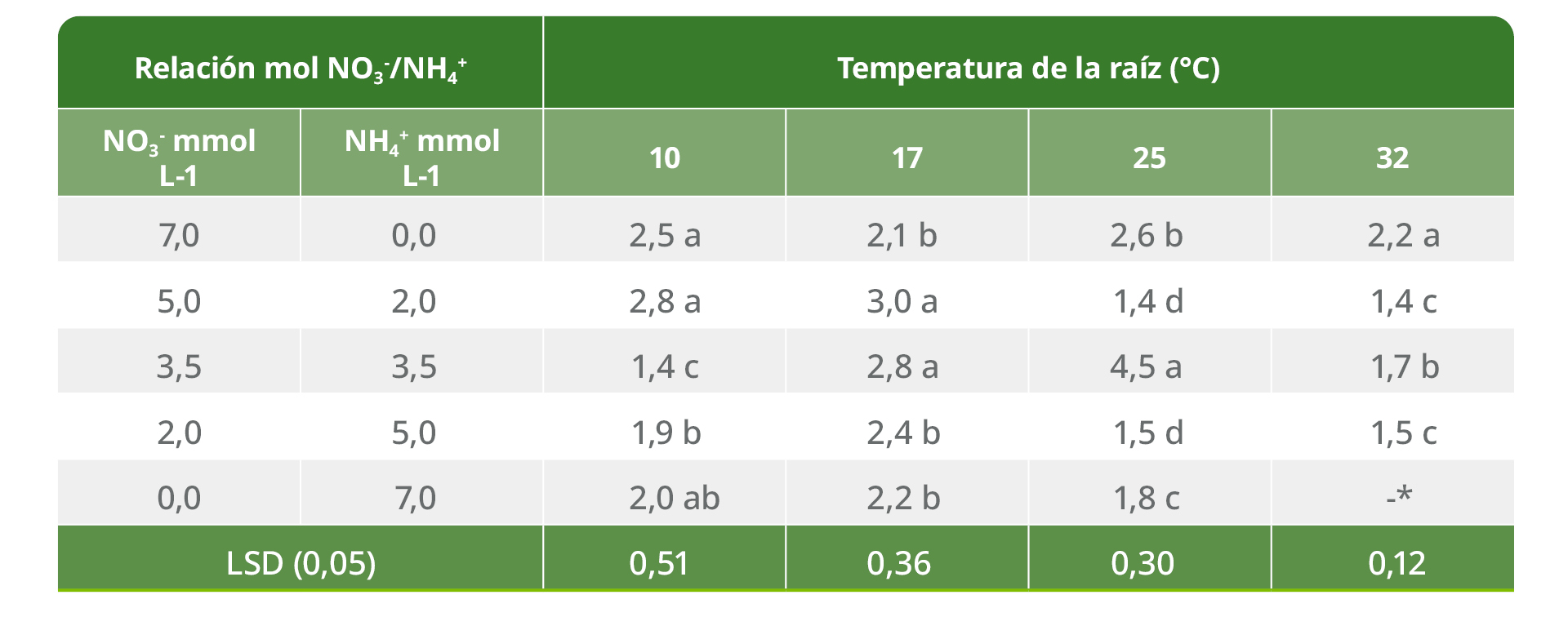
A higher dry matter content was found in plants nourished exclusively with NO3-, compared to plants nourished with NH4+ at extreme temperatures of 10° C and 32° C. In contrast, at normal temperatures of 17° C and 25° C, plants that received a nutrient solution with a maximum NO3-:NH4+ ratio of 1:1, obtained leaves with higher dry weight compared to NO3- alone (Table 1).
At low temperatures, NH4+ nourished plants showed no root damage, whereas at higher temperatures in the root zone, the roots of these plants disintegrated. The explanation for this is due to: it is most likely due to the fact that NH4+ metabolism occurs exclusively in the roots and requires carbohydrates within the root cells, while there is intense competition with respiration for sugar reserves. At higher temperatures the need for sugar in the other parts of the plant also increases, increasing this competition.
A significant effect of N form on cation concentration was found in most cases. In plants nourished with NO3-, K+, Ca2+ and Mg2+ the N concentration in roots was higher compared to plants nourished with NH4+. In the leaves, Ca2+ was also higher in plants nourished with NO3-. Leaf Mg 2+ was not affected by nitrogen form, and the effect of N form on K + varied with temperature, with higher K + in plants nourished with NO 3- at temperatures below 17° C. In relation to anion concentration, an increase in the concentration of NO3- in leaves of plants grown with any form of N. Chlorine and sulfur concentrations increased in plants nourished with NH4+ and P decreased in plants nourished with NO3-.
The balance of total mineral cation concentration minus total mineral anion concentration (C-A) is nominally equivalent to carboxylate anion concentration. This was found to be higher in leaves than in roots for all temperatures and forms of N. In roots, the nominal carboxylate content of roots decreased with increasing temperatures with both forms of N, and was higher in NH4+ nourished plants. In contrast, in leaves of NO3- nourished plants, carboxylate content was not temperature dependent, but was still negatively correlated in NH4+ nourished plants. Leaf carboxylate content in general was lower in NH4+ nourished plants than in NO3- nourished plants. This is explained by the reduction of NO3- in the leaves, which is linked to the production of organic acids, or to a higher consumption of carboxylates in plants nourished with NH4+ at higher temperatures. The authors indicate the importance of calculating the ionic balance as this allows us to understand carboxylate production in various plant organs, and to demonstrate the importance of the form of nitrogen in metabolism and consumption as a function of root temperature.
Table 1. Effect of root temperature and NO3-/NH4+ ratio on strawberry dry weight (grams of leaves/plant). Averages with the same letter are not significantly different between each root temperature treatment. * Dead plants due to root damage.
Author
Ganmore-Neumann, R. and U. Kafkafi, 1985. The effect of root temperature and nitrate/ammonium ration on strawberry plants. II. Nitrogen uptake, mineral ions and carboxylate concentrations. Agron. J. 77:835-840.