
Potassium nitrate sprays increased the yield of HLB-diseased citrus plantings.
Citrus, Disease, Disease, Foliar application, Fruit yield, HLB, KNO3,
Previously published research leaves no doubt that potassium nitrate is the preferred source of K for improving fruit set and fruit development in citrus through foliar applications of potassium nitrate.
Additionally, potassium nitrate is known to increase plant resistance to disease (Holwerda & Carruth, 2010). A new study, developed in Florida, USA has revealed a new added benefit of using potassium nitrate in citrus: mitigation of potential severe damage caused by a bacterial infection introduced by a vector (Rouse & Roka, 2015).
This five-year study (2008-2012) concluded that three sprays of potassium nitrate at 25 kg per ha per spray, applied during the three vegetative growth periods in March, June and September, resulted in higher net input increases averaging US$770 /acre/year (US$1925/ha/year) in orchards affected by Citrus Greening Disease (HLB).
Citrus Greening Disease (HLB - HuangLongBing or Citrus Greening Disease) is a bacterial disease that causes great economic damage and is one of the most important risks (threats) to citrus fruits grown in the world. This disease was confirmed in Florida in 2001 and spread to all citrus producing countries by 2009. The suspected culprit, a pathogenic bacterium (Candidatus Liberibacter asiaticus), can move very quickly because its vector is citrus psyllids and because there is a delay between infection and the demonstration of symptoms.
Infected trees may remain undetected for several years by not expressing symptoms, but effectively functioning as sources of inoculum.
Once active, the bacterium colonizes the vascular system of the tree, causing a pronounced decline in productivity and eventually the tree dies, within a couple of years. Affected trees show HLB symptoms on leaves over the years and become visibly yellow and chlorotic during the fall and winter. HLB symptoms in leaves with mottled spots resemble micronutrient deficiencies. So far, there is no cure for citrus greening disease.
In 2008, a trial was established by the University of Florida (IFAS/SWFREC) in its heavily HLB-infested orchard at Immokalee.
The objective was to confirm the spectacular results obtained with a cocktail of nutrients and bio-stimulants from a producer in southeast Florida, Maury Boyd, and to identify the efficacy of the separate components in the mixture: KNO3, macronutrients (3-18-20), micronutrients (Mn, Zn, Mo and B) and a selection of products that induce systemic resistance (SAR) to stress (phosphoric acid (H3PO3), salicylic acid and/or Bacillus subtilis).
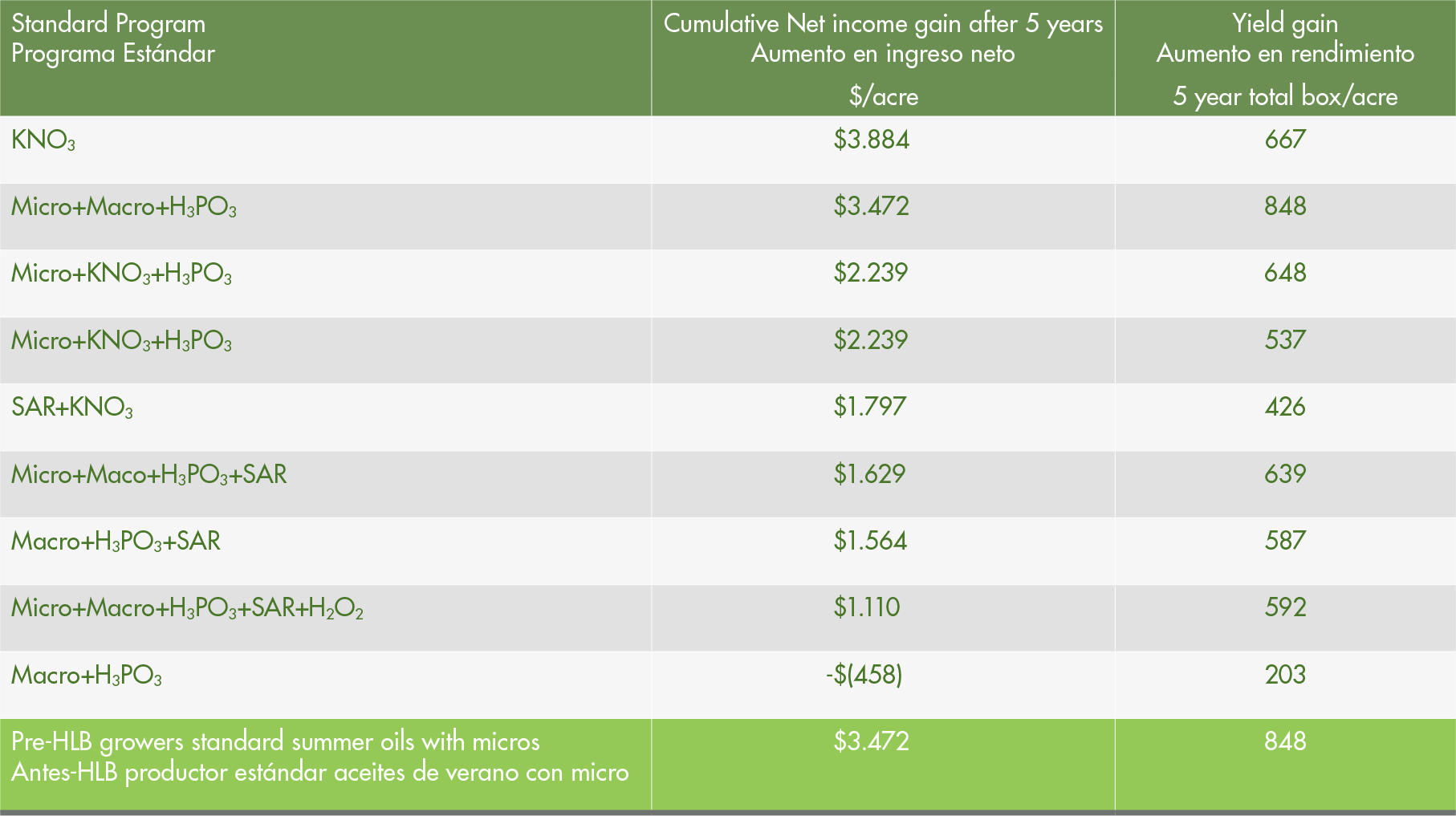
KNO3 was applied alone or in combination with other components. All treatments containing KNO3 doubled the yield compared to the control. However, there were some mixtures that added more to the yield than KNO3 alone.
It was concluded that a single application of KNO3 alone had the greatest net gain in yields when all costs of the nutritional program were considered. KNO3 alone or the Maury Boyd nutrient mixture containing KNO3enables the plant to produce new phloem (plant nutrients generating vascular tissues) to compensate for HLB-infested veins, and to remain largely free of HLB disease symptoms. This translates into higher yields compared to trees that received nutrient sprays without KNO3.
Table 1. Net gain in yield and revenue, per grower relative to the standard for growers prior to HLB infection. The increase in net revenue is derived by subtracting the additional costs for treatments from the aggregate revenue calculated from the yield gain, using the following assumptions: 150 trees/acre; 5.6 pounds of solids per box; $1.70 per pound of solids delivered in price; $3.00 per box to harvest and transport.
Author
Harmen Tjalling Holwerda