
Importance of Potassium in the Avocado Crop
Avocado, Fertilizer, Mexico,
A. Functions of potassium (K) in all higher plants.
The potassium cation K+ is the most abundant cation in the chloroplasts and cytosol of plant cells (the liquid matrix around the functioning cell organelles), but it is not fixed to any specific organ. High concentrations of potassium balance the negative charge of all kinds of organic and inorganic anions, thereby stabilizing and buffering the pH of the cytosol at 7-8, determining the osmotic potential of plant cells and tissues. It is highly mobile in plants at all levels: within cells, within tissues and in long distance transport via xylem and phloem. This high mobility allows it to become a multitasking factor in plant metabolism. In addition to its role in maintaining pH, EC and osmotic potential, K has an important effect on enzymes and coenzymes by stabilizing their structure and activity. These enzymes and coenzymes are involved in about one hundred physiological processes in plants, such as cell division, transpiration, photosynthesis, sugar and lipid metabolism, protein synthesis, biotic and abiotic stress reduction, winter tolerance, disease and pest resistance, fruit growth, and fruit quality before and after harvest.
Potassium plays an exceptional role in plant-water relations. It is fundamental in the regulation of water balance and turgor pressure, controlling the opening and closing of leaf stomata through the control of sugar concentrations in guard cells (see adjacent photomicrograph). Thus, it is potassium that greatly affects all photosynthetic and respiratory activity of the plant, affecting, in turn, all other functions of the plant apparatus.
Additionally, K+ is the main cation that accompanies anionic amino acids, fatty acids and sugars within the plant, from their source in the leaves to their deposits in the shoots, inflorescence, fruit set, developing fruits and all parts of the root system, feeding them with carbohydrates and amino acids.
B. The specific importance of an adequate level of K for avocado.
In view of the above facts, potassium plays fundamental roles, which determine the development of the avocado tree mainly in the following ways:
1. Resistance to heat and drought stress, especially during flowering, fruit set and the early stages of fruit development. This function is very important for final avocado yield since the tree is very sensitive to these stresses. If the stomata of the tree do not close immediately in the face of insufficient K nutrition, the tree may dehydrate rapidly. This will cause rapid flower drop, decimate the fruit set rate and drop the newly formed fruit. This could result in an almost complete loss of total yield for the season. Water stress can also negatively affect internal fruit quality (Moreno-Ortega et al. 2019).
2. Avocado fruit volume is initially composed of about 80% water, which normally decreases throughout the season and is replaced by oil (see Figure 1). An insufficient hydration status of the tree severely reduces fruit growth, especially if this happens at critical growth stages, during which the final fruit size is determined. This will have a detrimental effect on varieties that normally produce a significant share of small and less marketable fruit, such as the very popular 'Hass' variety.
As mentioned above, the avocado tree is very sensitive to heat. Fortunately, when the tree has a good hydration status, it can
cool itself by positively opening its stomata system. Massive, yet controllable, transpiration of water via its stomata system can considerably reduce the tree's temperature to a tolerable range. Therefore,
Triple function of the stoma
K+ cations guide sugars, amino acids, and fatty acids from sources to reservoirs such as shoots, flowers, fruit, and roots an adequate K status in the tree can minimize the damage that heat waves (current and those predicted for future decades) can cause to subtropical avocado plantations (Moreno-Ortega et al. 2019).
4. As mentioned in paragraphs 1 and 2, avocado fruit growth is characterized by a continuous reduction in water content and, in parallel, an increase in oil content. The major role of potassium in the synthesis and translocation of fatty acids has, therefore, a major effect on the growth process of avocado fruit, its size and its high nutritional value for humans as an excellent source of monounsaturated and polyunsaturated oils.
An additional aspect regarding the importance of potassium in avocado cultivation is that it serves as a superfood thanks to its very high K content (485 mg/ 100g), which is 40% higher (weight/weight) than a banana. Therefore, it is in the interest of consumers and producers to achieve a fruit as rich in potassium as possible.
5. Adequate K content in avocado fruit is a prerequisite for its postharvest life in terms of internal quality. The balance between potassium, calcium and magnesium concentrations is an important factor, which determines the color of its mesocarp (flesh). K deficiency, expressed as a high (Ca+Mg)/K ratio, significantly increases the brown coloration of 'Hass' fruit due to excessive polyphenol oxidase activity. K-deficient fruits easily reduce their aesthetic value by discoloration of their vascular system (Mhlophe & Kruger, 2013).
6. On the other hand, excessive potassium in the plant can increase transport in the phloem and decrease the level of calcium in the fruit due to depressed flow in the xylem. Therefore, the rate of potassium application should be carefully calculated.
7. The aforementioned interaction between K+, NH4+, Mg2+ and Ca2+ also takes place at the root level in the soil, in which all these cationic nutrients compete with each other to be absorbed by the roots of the tree. In this context it should be mentioned that K uptake by roots is highly selective and is closely linked to the metabolic activity of the avocado tree.
To summarize, it can be said that avocado trees must be supplied with copious rates of potassium to produce more fruit units and higher external and internal fruit quality. And since a large proportion of the nutrients that are absorbed from the soil end up in the fruit, which will eventually be exported from the orchard, it is essential to continually replenish potassium levels in the soil for the next season's crops.
C. Potassium uptake in avocado trees.
The avocado fruit is unique in that it can remain on the tree for up to 18 months after spring flowering, during which time the developing fruit is a strong recipient of nutrients. It is very important to supply the avocado tree with the necessary nutrients at the right time when they are physiologically required. A timely application maximizes yields, improves fruit quality, increases nutrient uptake and use efficiency.
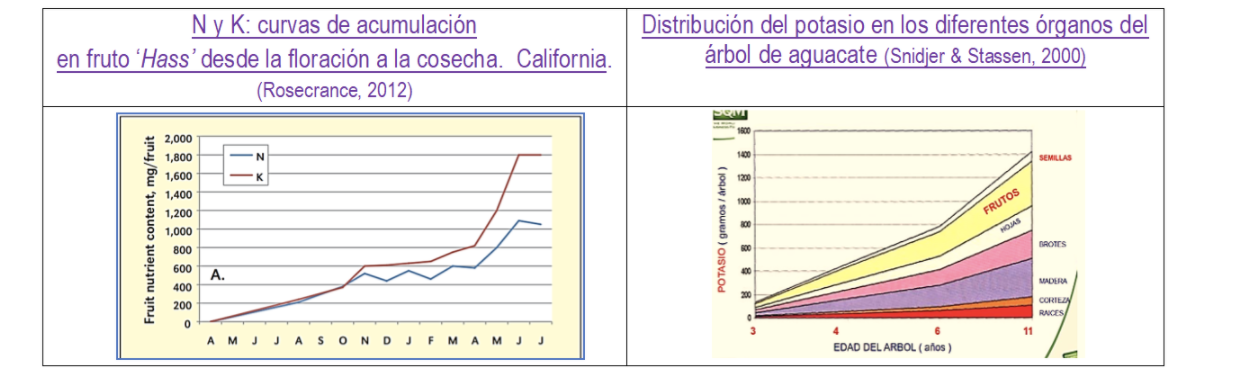
The figure on the left shows that nitrogen and potassium uptake rates are very similar during the early growth stages, but starting in November (northern hemisphere), the rate of potassium uptake increases markedly over that of nitrogen. The figure on the right shows that during all life stages of an avocado tree the highest rates of potassium concentrations are found in the trunk of the tree, somewhat less in the fruit and much less in the shoots.
Literature cited
Abercrombie, R.A. 2009. Fertilization. In: The Cultivation of Avocado (eds. De Villiers, E.A. & Joubert, P.H.), pp. 142-150.
Stones, W. 2009. Management in Brief. AvoInfo 166: 8-9
Lovatt, C. 2015. Optimizing 'Hass' avocado tree nutrient status to increase grower profit - an overview. VIII World Avocado Congress, Lima, Peru. 2015.
Rosecrance, R., Faber, B., Lovatt, C. 2012. California, Patterns of Nutrient Accumulation in 'Hass' Avocado Fruit. Better Crops, 2012, No. 1. Vol. 96. Pp. 12-13.
Guerrero-Polanco, F., Alejo-Santiago, G., Sánchez Hernández, Bugarín Montoya, R.R., Aburto-González, C.A., Isiordia-Aquino, N. 2018. Response of avocado crop, Hass variety to potassium nitrate application. Acta Agron.(2018) 67 (3) p. 425-430.
Mhlophe, S.D. & Kruger, F.J. 2013. Addressing the Postharvest Vascular Staining Disorder of 'Maluma' Avocado (Persea americana Mill.) Fruit. Proc. 2nd All Africa Horticulture Congress, Eds: K. Hannweg and M. Penter. Acta Hort. 1007, ISHS. 2013
Author
/O. Achilea. Ph.D.