
Potassium nitrate increases crop tolerance to pests and diseases
Disease, Disease resistance, KNO3, Pest management, Potassium,
As global efforts focus on preventing food shortages in the coming years, scientists are looking for new solutions to prevent the proliferation of infections - existing and emerging - in plants.
A key solution that requires further examination is the use of potassium: potassium (K) is essential for protein, starch and cellulose synthesis in plants. Its deficiency causes cell walls to leak, resulting in high concentrations of sugar (starch precursor) and amino acids (protein building blocks) in the apoplast.
When potassium is sufficient, there is an increase in the synthesis of high molecular weight compounds such as proteins, starches and cellulose. This depresses the concentrations of low molecular weight compounds such as soluble sugars, organic acids, amino acids and amides in plant tissue. These concentrations of low molecular weight compounds allow the development of infections and insect infestations. As shown by numerous studies, lower concentrations of these compounds produced by sufficient levels of potassium (K) make plants less vulnerable to disease and pest attacks. Adequate K levels increase phenol concentrations, which plays a role in plant resistance. The synthesis of other defensive compounds in plants with sufficient K results in higher mortality of eventual pests.
After reviewing 2,449 references, one research study produced impressive findings: the use of K decreased the incidence of fungal diseases by 70%; bacteria by 69%; insects and mites by 63%; viruses by 41%; and nematode incidence by 33%. In parallel, Potassium (K) increased the yield of plants already infested with fungal diseases by 41%; with bacteria by 57%; with insects and mites by 36%; with viruses by 78% and with nematodes by 19%.
At least 125 million tons of the five major food crops (rice, wheat, maize, potatoes and soybeans) are lost annually due to fungal infections. Fungal damage to rice, wheat and maize alone costs global agriculture US$ 60 billion per year. Imagine what could be achieved if potassium were used to help control all pests: fungi, viruses, bacteria, insects and nematodes!
Nutrient management has enormous potential as part of Integrated Pest Management (IPM). The use of K is a great example of this. In addition, many studies have shown that leveling N and K results in an even greater positive impact on the development of pest resistance. Nitrogen (N) and Potassium (K) together can effectively balance plant nutrition and become a key weapon in the IPM arsenal.
Potassium nitrate added to aerosol surfactant suppressed aphid populations on pecan nut.
The objective of the study was to verify whether early season spraying of pecan nuts with potassium nitrate/surfactant (PN + S) alone would increase pecan yield. The treatments did not influence yield components; nor did they influence foliar K nutrition or net photosynthesis, but they did suppress "yellow-type" aphid populations on pecan trees. Sprays with water alone suppressed aphid populations, but the addition of KNO3 (0.5%) plus surfactant (0.15%) resulted in an additional level of suppression (Figure 1).
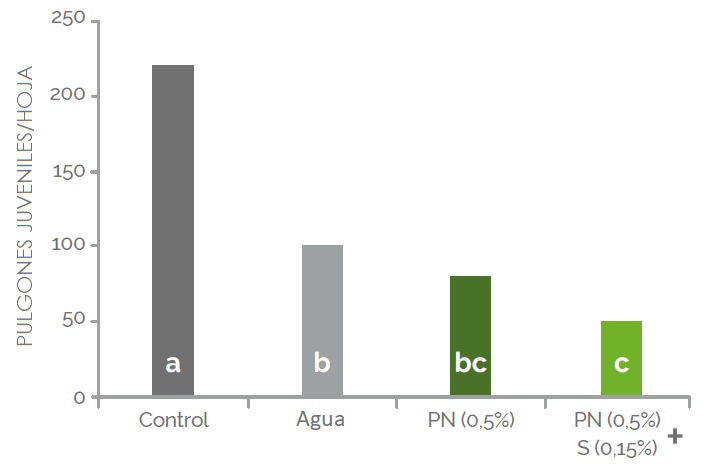
Influence of foliar sprays on juvenile populations of yellow-type pecan aphids on pecan foliage 1 day after spraying.
Treatments: control (no spray), water, potassium nitrate and S, surfactant, Sears trisodium phosphate-based detergent. Wood, B. W., J.A. Payne and M.T. Herrero. 1995. Suppression of pecan aphid populations using potassium nitrate plus surfactant sprays. HortScience, 30 (3): 513-516.
Adequate potassium nutrition improves plant resistance to pathogens and insects through many mechanisms.
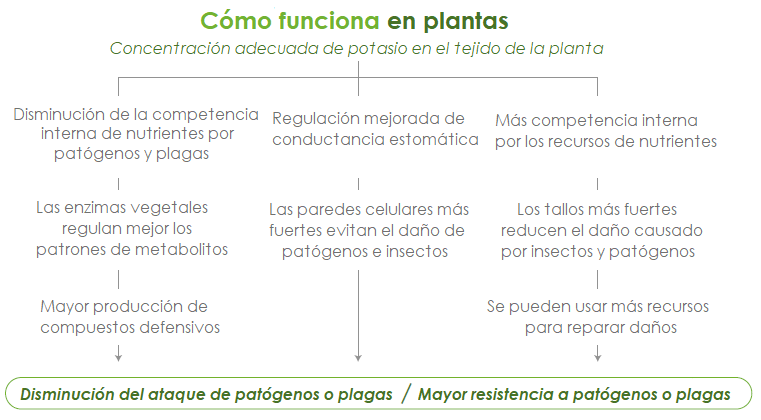
Figure adapted from Wang et al., 2013.
The presence of sufficient potassium also promotes the production of defensive compounds (such as phenols) that are an important component in plant pest resistance. Adequate potassium concentration within the plant decreases internal competition with various pests and pathogens for resources. This results in more resources available to harden cell walls and tissues to better resist penetration by pathogens and insect pests, and to repair any damaged tissue. Airborne pathogens are more quickly shut down from stomatal invasion when there is an adequate amount of Potassium (K).
Wang, M. et al. 2013. Internat. J. Molec. Sci. 14: 7370-7390. Available: https://www.mdpi.com/1422-0067/14/4/7370.
BY JW LEMONS National Sales Agronomist SQM North America - Published in CropLife magazine, August 2019.
Author
JW LEMONS National Sales Agronomist SQM North America