
Why potassium nitrate is the preferred source of K and N for plant growth
KNO3, Nitrate, Nutrient, Potassium, Soil,
Potassium nitrate from natural resources: efficient plant growth.
Nitric nitrogen
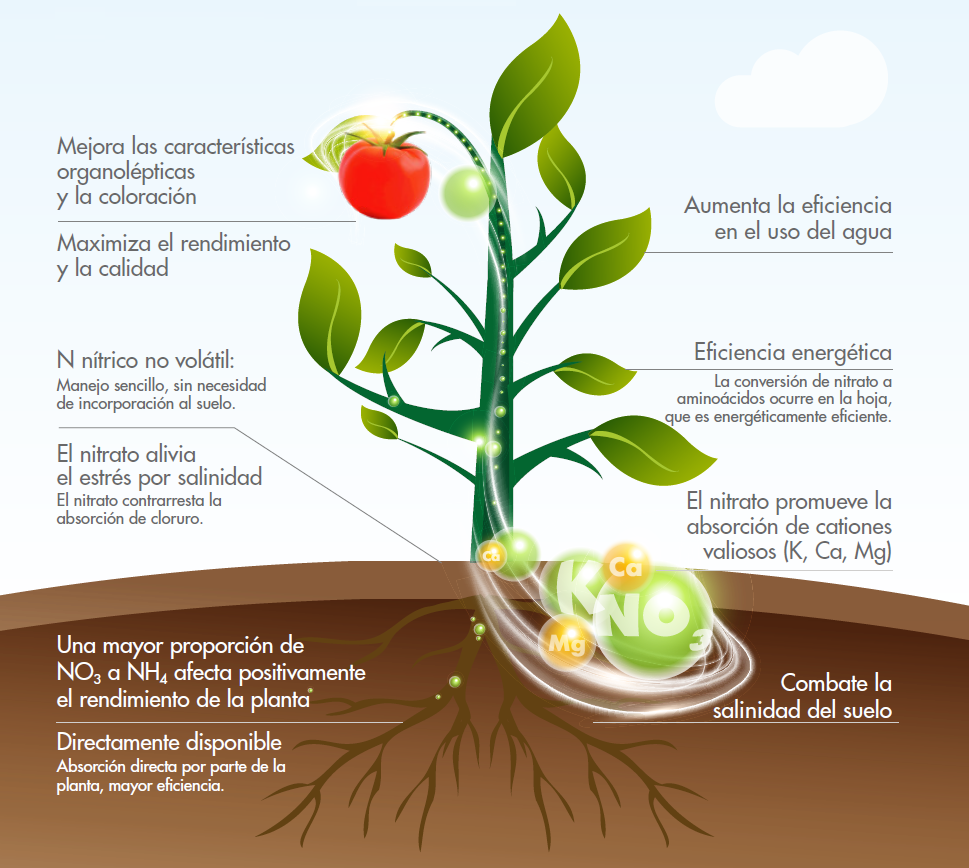
Nitrate: Nitrate is the preferred source of nitrogen:
Non-volatile Unlike ammonium, nitrate is not volatile and does not require incorporation into the soil when applied as a top dressing.
Directly available Direct absorption by the plant.
Nitrate promotes the uptake of valuable cations. While ammonium competes for the uptake of K, Ca and Mg.
Nitrate can be readily taken up by the plant. Urea and ammonium must first undergo chemical conversions in the soil before they are available to plants.
Does not acidify the soil Ammonium must go through a nitrification process before it becomes available, a process that increases soil acidity.
Nitrate limits chloride absorption. Ammonium can lead to increased chloride absorption.
The conversion of nitrate to amino acids occurs in the leaf. Ammonium must be converted to organic N compounds in the roots, which it achieves by stealing carbohydrates from growth-promoting processes
Potassium
Essential functions
Potassium promotes photosynthesis and the transport of sugars to fruits, and plays an essential role in the production and accumulation of oils.
Potassium maintains season-long leaf function in terms of increasing yields and delivering higher soluble solids content (more sugars) to fruit at harvest.
Main functions
Promotes protein production Rapid conversion of inorganic N to proteins.
Promotes photosynthesis IncreasedCO2 assimilation, resulting in increased sugar production.
Intensifies carbohydrate transport and storage. More energy flows from leaf to fruit for better yields.

Figure 1.
Increases nitrogen fertilizer efficiency Increased nitrogen use efficiency (NUE) generates higher yields and prevents unwanted N losses to the environment.
Improves water use efficiency Regulates the opening and closing of stomata, resulting in less water requirement per kg of plant biomass.
Synthesizes lycopene Lycopene synthesis creates an intense red color in the fruit.