
Phenology model: timing of potassium nitrate sprays for citrus fruit size increase and retention
Foliar, Foliar application, Foliar Application, Fruit retention, fruit retention, KNO3, Nutrient, Nutrient, Orange, Orange, Performance, Potassium nitrate,
The purpose of this research was to identify the essential role that nutrients play in tree physiology, and therefore to apply the nutrient as a foliar fertilizer to stimulate a specific metabolic process at phenological stages when nutrient demand is high.
During fruit set, when flower and fruit abscission occurs, a high gain in fruit retention and yield can be achieved (Figure 1). At low temperatures, root activity is limited, resulting in lower nutrient uptake. Early pre-bloom and post-bloom nitrogen sprays with fertilizer sources, such as urea or KNO3, can help solve this problem of limited root activity. Nitrogen absorbed foliarly will be fractionated into ammonium, which will be metabolically transformed into arginine and arginine into polyamines. Polyamines play a well-established role in promoting growth through cell division. Usually, more cells means larger fruit. Seventy percent of the final fruit size is related to the number of cells in the fruit. Generally, cell division stops at the end of April (Florida); the change in size throughout the rest of the year comes from cell enlargement.
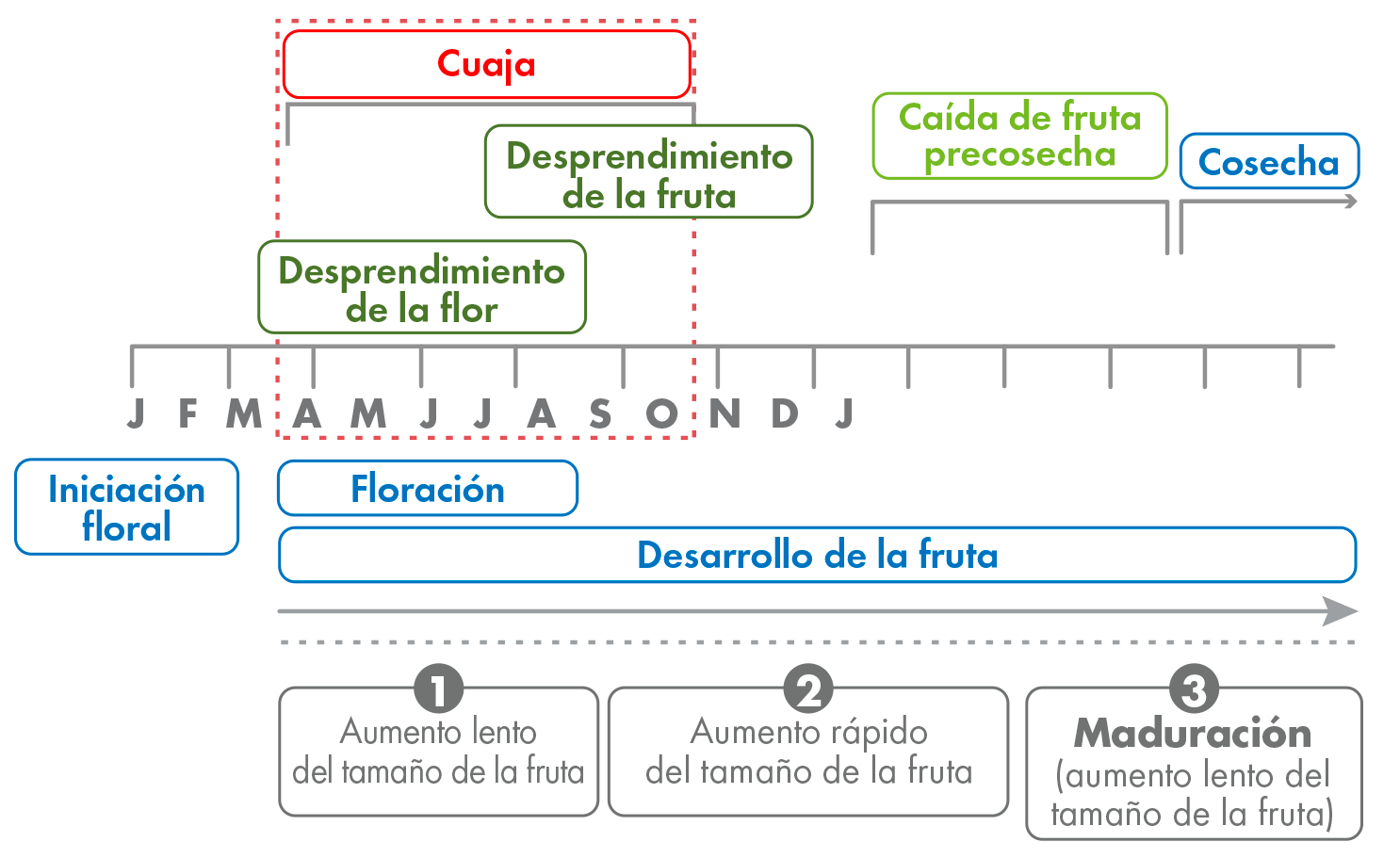
Navel Orange phenology model based on 25-year-old 'Washington' Navel Orange (Citrus sinensis L. Osbeck) trees of 'Washington' in the Troyer [Poncirus trifoliate (L. Raf) x C. sinensis] rhizome citrus range in Riverside CA.
Author
Lovatt, C.J. 1999. Timing Citrus and Avocado Foliar Nutrient Applications to Increase Fruit Set and Size. HortTechnology. October-December 9(4): 607-612.